







That voice in your head that keeps whispering:
“You’re not ready,”
“You’re not good enough,”
Wouldn’t it be nice to destroy it… permanently?
Well in this article, I’m sharing exactly how you can… and it doesn’t involve confidence tricks or positive thinking.
No matter how skeptical you are, or how much that inner voice is ruling your life right now, if you follow these 5 steps, self-doubt WILL lose its power.
Let’s get started with step number one…
1. Stop Treating Self-Doubt Like A Verdict
Most people see self-doubt as evidence about who they are. Like, “If my brain is telling me I’m not good enough, it must be true.”
But the truth is, self-doubt doesn’t show up when you’re incapable; it shows up when you’re stepping outside a familiar version of yourself.
Let me explain…
Your brain’s primary job is to keep you safe. Familiarity feels safe, while anything unfamiliar feels dangerous.
So if anything unfamiliar (even something you consciously want) arises, it gets flagged as a threat.
To deal with this threat, your brain creates self-doubt to try to convince you to avoid the supposed threat.
When you understand the truth about self-doubt, you see that the thought, “I’m not ready,” doesn’t actually mean you’re not ready. It means “This version of me hasn’t done this before, and so, I’m scared.”
While your brain perceives it as a threat, it’s simply the presence of a new identity.
That’s why it’s completely normal to experience high levels of self-doubt right before taking a risk, trying something new, or doing anything that means you’re growing.
Here’s something you can do to start seeing self-doubt for what it really is…
The next time you notice an unhelpful thought like “I’m not good enough?” pause and ask yourself, “What identity is being stretched right now?”
2. Your Brain Doesn’t Respond To Reassurance, It Responds To Evidence
Here’s where most people accidentally make self-doubt worse. When that unhelpful inner voice shows up, they try to reassure themselves through self-affirmations, like:
“I am confident.”
“I can do this.”
“I’ve got this.”
While there is nothing wrong with using affirmations, their effect is only superficial.
You see, encouragement doesn’t calm our nervous system; PROOF does. It needs to see evidence that you can survive whatever this new, unfamiliar thing is.
When it senses a threat, your brain asks one question: “Have we done something like this before and survived?
If the answer is no, your brain tightens its grip, making self-doubt louder and louder.
To calm the self-doubt and your brain, you need to update its beliefs through BEHAVIOR, not declarations.
In psychology, this is called self-efficacy — the belief that you can handle what’s coming because you have evidence that you already have. And this evidence comes from follow-through.
So instead of asking, “How do I make myself feel more confident?” ask, “What evidence can I give my brain today?”
3. Self-Doubt Exists In The Gap; Identity Is What Closes It
Self-doubt lives in the gap between what you’re doing and who you still think you are. So when self-doubt arises, it’s a sign that your behavior is ahead of your identity.
Here’s an example…
Most people are perfectly capable of sharing an idea, asking a question, or offering an opinion.
And yet many people stay silent. Not because they don’t know what to say, but because it doesn’t yet match how they see themselves.
They believe “I’m not the kind of person who speaks up,” and so they don’t speak up.
But here’s what would happen if they ignored their self-doubt and spoke up anyway…
- They would give their brain evidence that they ARE the kind of person who speaks up.
- That evidence would then update their identity.
- Once their identity updates, the self-doubt would lessen because it has nowhere to live.
Because that’s exactly what happens when you give your brain evidence: it doesn’t just build confidence; it updates your identity.
Each action is a vote, and enough votes rewrite who you believe you are.
4. Don’t Let Self-Doubt Sit Long Enough To Fossilize
So how can you take action in the midst of self-doubt?
The trick is not to give it time to take hold.
When self-doubt creeps in, we stall. We think it’s a signal to take time to think and analyze the situation.
But the longer we do this, the stronger the self-doubt becomes… and the harder it is to take action.
So here’s the rule I want you to adopt:
When self-doubt shows up, you have 24 hours to act.
Action interrupts the self-doubt loop. It sends a signal to your nervous system that “We’re not in danger. We’re moving.”
And once that signal goes out, self-doubt loses leverage.
This doesn’t mean you have to do anything huge. Even a small action can loosen the grip of self-doubt.
- Send the email — not the whole pitch
- Book the call — not the life plan
- Publish the post — not the perfect brand
Every time you override self-doubt quickly by taking even a small action, self-doubt weakens.
5. The Goal Is Not To Eliminate Self-Doubt, It’s To Outgrow It
You heard that right, what we’re doing here is outgrowing self-doubt, not eradicating it.
So rather than focusing on “How do I get rid of self-doubt?”
Ask yourself, “What kind of person would this doubt no longer make sense for?”
Because the truth is, self-doubt doesn’t disappear when you finally become fearless. It disappears when it no longer fits who you are.
Think about something you do easily now that once terrified you. Maybe it’s driving, speaking a second language, or speaking in front of a crowd.
You didn’t eliminate the fear before you started doing that thing. You felt the fear and did it anyway, and by taking action in the face of it, you outgrew it.
There might still be moments when that self-doubt shows up, but you’ve created enough evidence around that identity that the self-doubt no longer has the power to stop you.
Want To Learn More About Outgrowing Self-Doubt?
In this week’s YouTube video, I explain these 5 steps in much more detail, with personal stories of my own experience with self-doubt.
Here’s where you can watch it:
If you’d like some further guidance, I invite you to join The Reset — My free, five-day guided challenge designed to interrupt self-doubt patterns and calm your nervous system. With daily prompts and practices, you’ll learn how to stop spiraling and start taking action to update your identity.
Why not take the first action now by commenting below the new identity you’re ready to step into!
Resources:
- My Free, 5-Day Guided Challenge: The Reset
- My Free Class for Health Coaches: How To Build A 6-Figure Health Coaching Business Using One Signature Program
- Dr. Kim on Instagram: https://www.instagram.com/drkimfoster/
JOIN THE INSIDER LIST!
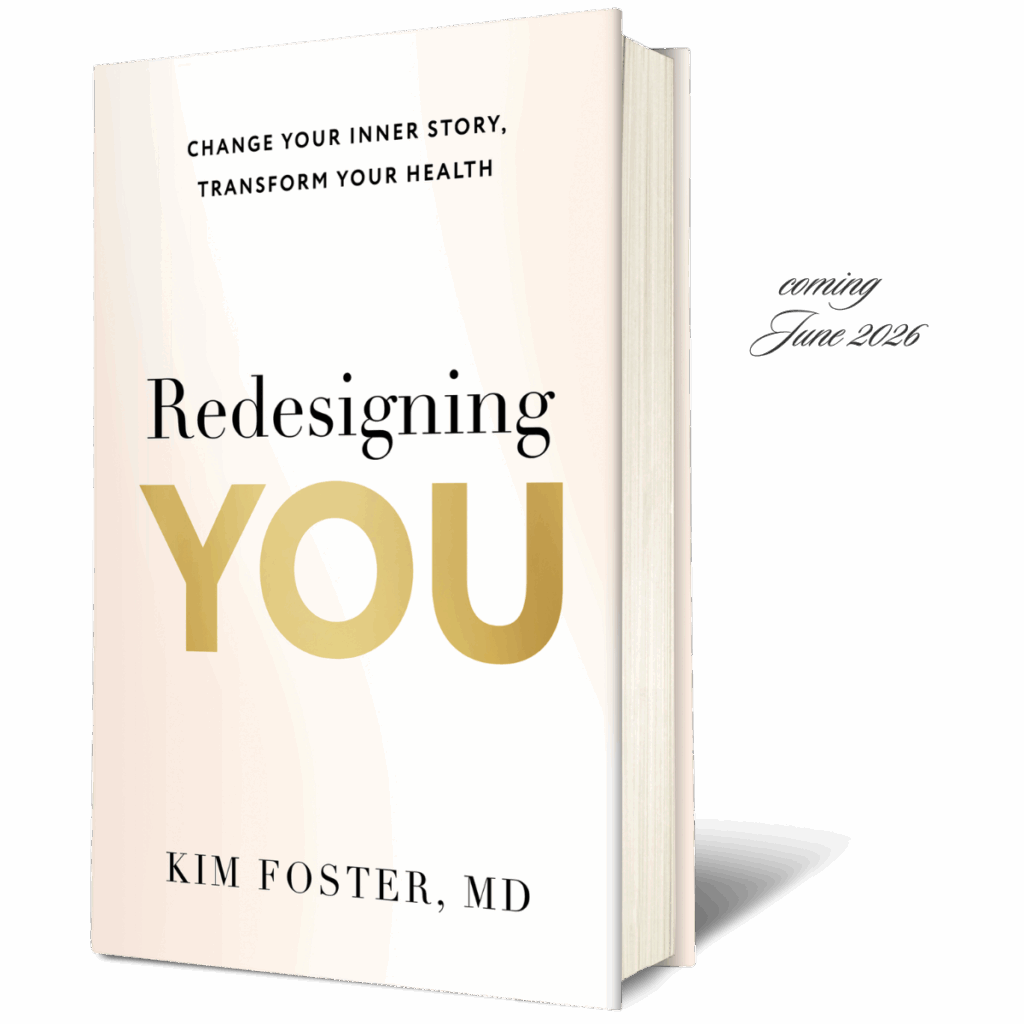
If you’re interested in my upcoming book Redesigning You, the Insider List is the best way to stay connected.
You’ll receive early updates, behind-the-scenes notes from the writing and publishing process, and first access to excerpts as they become available.
No spam. Just thoughtful updates, shared occasionally.