






Do you worry that people find you boring?
Do you feel awkward in social situations or struggle to express yourself the way you would like to?
If you’ve ever wished you could be more confident, more charismatic, and more magnetic, this article will help you become just that.
Because here’s the thing… You’re not boring or awkward. But you are unknowingly quietly killing your magnetism.
Here are 5 habits that are likely keeping you small without you even realizing it.
The Self-Shrinking Reflex
This is the habit of making yourself just a little smaller than you actually are.
Now I’m not talking about physically shrinking by hunching or folding inwards (which is absolutely a real thing), but about shrinking yourself energetically and emotionally.
We so often unconsciously do this with the words we say, like:
- “Oh, it’s no big deal.”
- “It’s fine, really.”
- “It was nothing, I just got lucky.”
When we say these things, we think we’re being modest. But what we’re actually doing is downplaying our achievements, strengths, and qualities, and sending signals of insecurity and lack of self-belief.
Brushing off a compliment or downplaying something is like saying, “I don’t belong here.” And nothing kills magnetism faster than that.
I used to be painfully shy and never felt like I belonged in the room, no matter what the room was.
And because I carried that belief, people started treating me accordingly, assuming that I didn’t want to be included.
And that’s the heartbreaking thing about this habit. By sending signals that we’re not worthy of taking up space, we become even more invisible.
It took me years and a lot of inner work to realize I already had the right to take up space, I just wasn’t claiming it.
You already have it too, so start claiming it, not in a dramatic, in-your-face way, but with subtle adjustments, like:
- Sitting up straight in your chair rather than slouching
- Speaking at your actual volume rather than a softer version.
- Letting a compliment land without batting it away (bonus points if you respond with “I appreciate that.”)
- The Over-Apologizing Loop
As a Canadian, I’m guilty of this one more than most.
It’s in our culture to apologise for EVERYTHING. And by everything I mean:
- When someone bumps into us.
- When we bump into an inanimate object (yes, really!)
- When we want to ask a question or simply say something
We think we’re being polite, but many of us are unaware that excessive apologizing doesn’t read as “polite.”
It reads as “Your comfort is more important than my presence.” Or even “I shouldn’t take up too much space.”
And that quietly, subtly kills our magnetism.
Research shows that unnecessary apologies lower your perceived confidence and social status.
How?
Every (unnecessary) apology we make is a little breadcrumb of self-doubt. And people sense them immediately. So the more we unnecessarily apologise, the more others can feel our lack of confidence.
And noticing how I’m saying “unnecessarily apologise.” Because this isn’t about becoming rude or evading accountability.
Sure, if you’ve actually done something wrong, you should absolutely apologise. But you shouldn’t apologize for asking a question, expressing your opinion, or simply existing.
Here’s how you can replace those disempowering “sorrys”:
- Instead of “Sorry I’m late,” say “Thank you for your patience.”
- Instead of “Sorry, can I ask a question?” say: “I have a question.”
- Instead of “Sorry, could you repeat that?” say “Could you repeat that for me?”
Once you stop excessively apologising, others will be drawn towards you because you’re sending the energy that you trust yourself enough to show up without shrinking.
- The Over-Explaining Habit
This one is sneaky because over-explaining doesn’t feel like insecurity; it feels like being thorough.
But what it actually signals is, “I don’t trust my words to stand on their own.”
Here’s how we do it without realising:
We answer a question, and then follow up with three disclaimers, two clarifications, and a bonus lecture… just in case.
Or we launch into a full list of justifications when someone makes a strange facial expression at what we said.
Or the classic: we follow every sense up with “Does that make sense?”
When I started coaching, I did this all the time. I would give National Geographic-level explanations because I was terrified of being misunderstood.
But the more I explained, the less confident I sounded.
What over-explaining communicates is uncertainty, fear of being judged, or a need for reassurance.
Once I learned to trust my first answer and let my words land without immediately seeking reassurance, everything shifted because magnetism thrives on grounded ease.
So try this instead:
- Give your answer and stop one sentence earlier than feels comfortable.
- Replace “Does that make sense?” with: “I can go deeper if you’d like.”
- The Validation Chase
The fourth habit is the constant scanning of other people’s faces, reactions, and micro-expressions to evaluate yourself.
On the outside, you’re talking. But on the inside, your mind is racing with thoughts like, “Do they like this?” “Do I sound okay?” “Should I dial myself up or down?”
The moment your mind spirals, you leave your body and slip into performance mode, observing yourself rather than being present.
Psychologists call this “self-monitoring.” A little bit of this helps us adapt in social situations. But too much (like in this case) creates social anxiety, weakens vocal resonance, lowers perceived leadership, and reduces trust.
As Harvard psychologist Amy Cuddy says, presence isn’t a performance; it’s trusting your own narrative.
And when you’re scanning for validation, you’re not believing or trusting your own story. You’re waiting for someone else to tell you whether it’s acceptable.
So the next time you speak, whether in a meeting, a conversation, or on camera, say your thoughts and resist the urge to look around to see how it landed.
Magnetism begins when you stop outsourcing your self-concept and allow the room to adjust to you. Not the other way around.
- The Neutral Persona
This final habit shows up as smoothing out your edges so you can be universally liked and unproblematic.
In other words, dimming your personality, views, and opinions, and staying neutral on EVERYTHING.
It feels safe to do this, but when you try to be liked by everyone, you also become forgettable to everyone. By staying neutral, you don’t leave any mark on your social interactions.
Plus, let’s be honest, NO ONE is liked by everyone anyway. Even if you’re thoughtful, kind, and warm, someone will still decide you’re “not for them.”
And guess what? That’s completely fine. You don’t have to be FOR everyone to be magnetic. You only have to be for YOUR people.
Studies on social connection show that vulnerability, humor, and imperfections create far stronger relational bonds than being universally agreeable.
So stop being agreeable when you have an opinion.
Stop watering down your enthusiasm, just in case it’s “too much.”
To break the habit, start small: share one genuine opinion, one real laugh, one specific detail about your life.
The more you stop dimming yourself to avoid rejection, the more your personality will begin to shine, and the more magnetic you’ll become!
Want to go deeper into these five habits?
In this week’s YouTube, I talk through each of these five habits in more depth, explaining the psychology around them and sharing real-life examples of how they quietly kill our magnetism:
And if you want help becoming the most magnetic person in the room, I invite you to join me in The Reset.
It’s my free 5-day challenge designed to shift your energy, your focus, and honestly… your identity in a very real, practical way.
Resources:
- Dr. Kim on Instagram: https://www.instagram.com/drkimfoster/
- Join me in THE RESET: My Free 5-Day Challenge to Boost Energy, Focus & Mindset
- My Free Class for Health Coaches: How To Build A 6-Figure Health Coaching Business Using One Signature Program
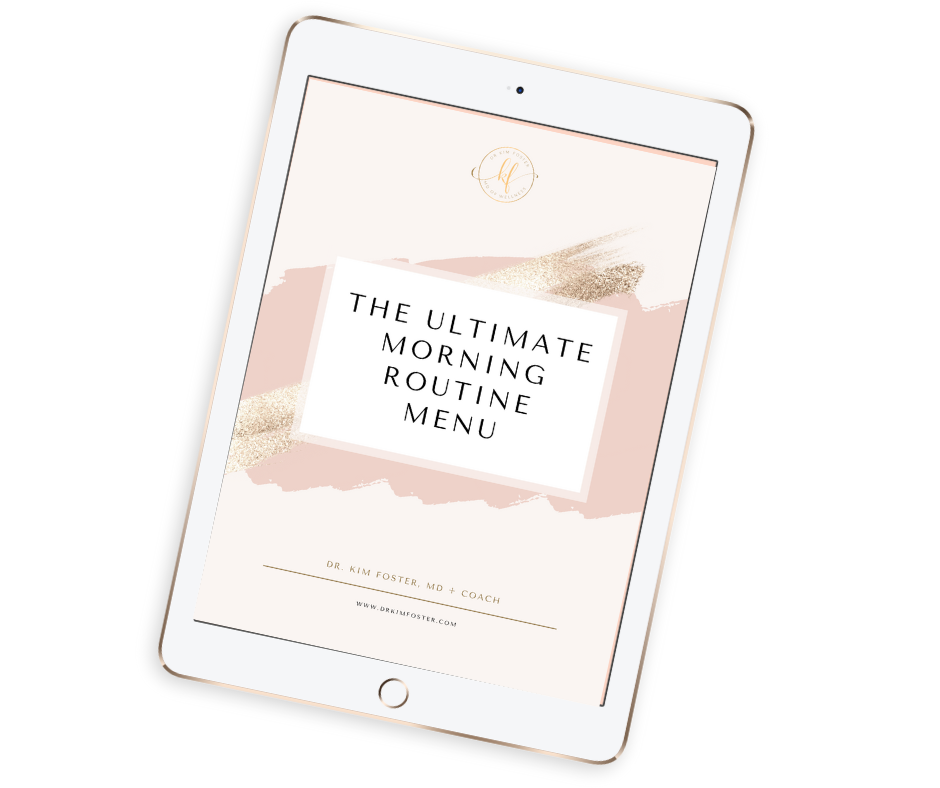
Download my FREE Ultimate Morning Routine Menu

FREE CLASS!
Looking to take your wellness journey to the next level?
The 3 Secrets For Stepping Into A Meaningful New Career Without Wasting Time Or Money
- find out why health & wellness coaching is a skyrocketing industry that can provide the freedom and fulfillment you’ve been craving
- discover the 3 biggest myths about health & wellness coaching that will hold you back (and what the truth is instead)
- learn the secret sauce for getting amazing results for your clients (and building a profitable business as a wellness coach)
…and more!