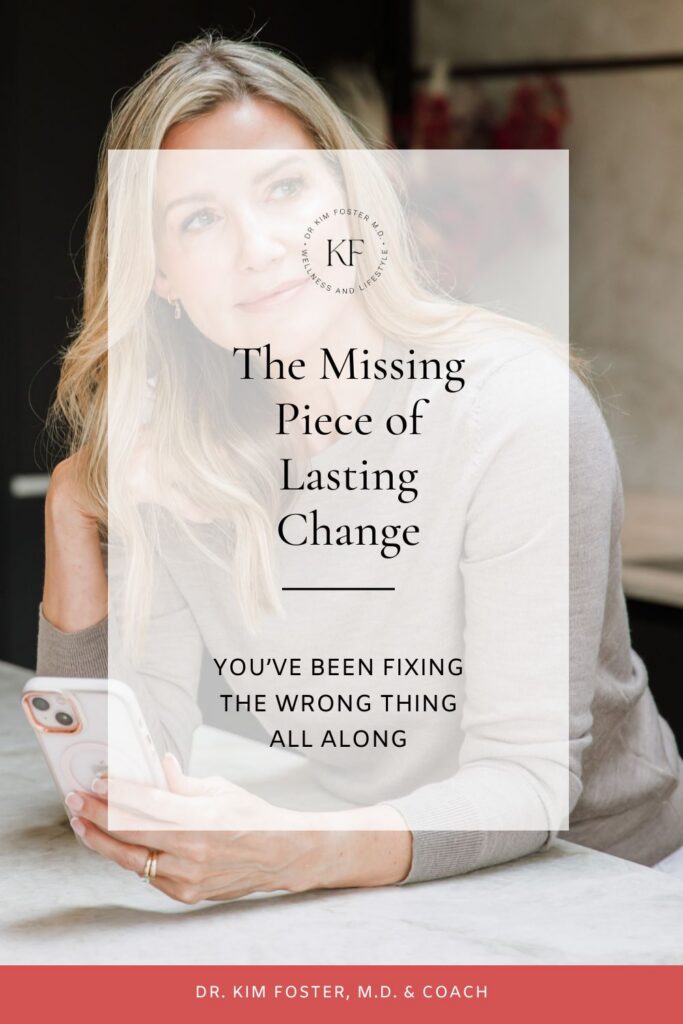







You’re no stranger to self-improvement. In fact, you’ve lost track of how many times you’ve tried to change your life before.
From the diets to the morning routines to the productivity apps, you’ve tried it all, believing that your latest method was definitely going to be the one that changed everything.
But it wasn’t.
It’s probably not that you were doing something wrong or that you didn’t try hard enough. But rather, there is something deeper that you’ve never addressed, because most self-improvement advice never points to it.
And that’s exactly what this article is about. Because once you understand the missing piece, you’ll finally be able to put an end to that frustrating trying-and-stopping cycle.
The Hidden Reason We Keep Failing
When a change doesn’t stick, most of us interpret it in one of two ways.
Either: “I didn’t want it badly enough.”
Or: “The method was wrong.”
So we try harder, we make a new plan, or we try a different strategy.
But there’s a third possibility most of us don’t consider: the repeated attempts themselves may be shaping the way you see yourself.
Every time you try something and fail, a small piece of evidence gets filed away about who you are.
- You tried going to the gym. But it didn’t last.
- You started a new diet. But you stopped after two weeks.
- You promised yourself you’d wake up earlier. But you snoozed the alarm.
Over time, these experiences create a story you subconsciously believe about yourself, like “I’m not consistent” or “I never stick to anything.”
And this story then starts influencing your future behavior in a way that reinforces the exact identity you’re trying to escape.
What We Keep Trying To Fix
Most self-improvement advice starts with behavior.
Something isn’t working, so you decide what you’re going to do differently. You create a schedule, set reminders, track your progress, and hold yourself accountable.
None of that is inherently wrong. But the real problem is the assumption buried inside the behavior. The assumption that if you engineer the right conditions around yourself, the change will happen TO you.
Think of it this way: behavior is the output, identity is the engine. You cannot change the output without first fixing the engine.
So how do we fix the engine?
It starts with a tiny language shift.
There’s a big difference between saying “I’m going to start running three times a week” and “I’m a runner.”
The first is a plan. The second is an identity.
This is why two people can follow identical advice and get completely different results. The person who plans to run three times a week is much more likely to cancel a run than the person who sees themself as a runner.
Why?
Because canceling a plan doesn’t threaten your sense of self, but canceling something that’s part of who you are does.
One person is forcing themselves to execute a plan. The other is expressing something that already feels consistent with who they are. And when motivation inevitably drops, the second person has something deeper supporting the behavior.
The Actual Problem — Identity
When I talk about identity, I don’t mean your values or who you want to be. I mean the operating story that’s running the show and sorting everything that comes at your life into two piles: that’s for me, and that’s not for me.
These beliefs often operate outside of your conscious awareness, and so they can feel less like beliefs and more like facts, which makes them hard to identify.
However, one place your beliefs tend to manifest is in your self-talk.
Psychologist Ethan Kross’ research on self-talk shows that the language we use with ourselves doesn’t just reflect how we feel; it can actually change our perspective and our actions.
In other words, the story you tell yourself shapes your behavior, and your behavior then reinforces the story. Which means the loop can run in either direction. It can trap you, or it can become the thing that sets you free.
How to Spot the Identity Mismatch
So how can you tell whether your identity is getting in your way? Whether your story is running you rather than you running the story?
Here are 3 signs to look out for:
1. You keep stopping just when things are starting to stick
You’ve survived the uncomfortable beginning. The behavior is finally starting to require less effort, and you’re beginning to build momentum.
And then suddenly, you stop.
This happens because the new behavior has started to move ahead of your existing identity.
And so, it creates friction, which can show up as a loss of motivation, a shift in focus, or simply deciding to take a break.
2. The new behavior feels like a costume
You’re doing the thing, such as going to the gym or learning a new language, but it doesn’t feel like you. You feel like you are performing, like you’re pretending to be someone else.
This is another sign that your behavior is ahead of your belief.
You’re acting like the person before you fully believe you are the person. That gap feels uncomfortable, and so, you interpret it as evidence that you’re in the wrong place, doing the wrong thing.
3. Your goals always exist in the future
I’m trying to become more disciplined. I’m working towards being healthier. I’m going to become someone who prioritizes myself.
Do these statements sound familiar?
The future tense is safe. When you say you’re trying to do something, planning something, or thinking about something, you’re keeping the identity at arm’s length and keeping the pressure off.
But this state of perpetually becoming feels so comfortable that sometimes, we get stuck there and we never actually let ourselves become the thing.
How to start changing the story
If you recognize yourself in any of this, you don’t need another morning routine, another app, or another journal to sit untouched on your desk.
Instead, follow this simple 3-step sequence:
Step 1: Name the current identity
You can’t change a story you haven’t identified, so start by completing these sentences honestly:
- “People like me don’t really…”
- “I’ve always assumed I’m just not someone who…”
Don’t write what you want to believe; write what you actually believe because bringing your story into awareness gives you something you can question.
Step 2: Start collecting different evidence
Once you know what your story is, start looking for small pieces of evidence that challenge it.
Maybe you went for the walk even though you didn’t feel motivated. Perhaps you finished something you normally abandon. Or maybe you had the difficult conversation you’ve been avoiding.
These moments might feel insignificant, but they’re tiny doses of proof that help your brain start to believe that actually, maybe it’s time to update the internal story.
Step 3: Change the sentence
You don’t need to jump from: “I’m trying to become someone who exercises.” to “I’m a professional athlete.”
If the new statement feels completely untrue, you’re unlikely to believe it. So instead, find something that feels both aspirational and believable, like:
- “I’m someone who takes my health seriously.”
- “I’m someone who follows through on the promises I make to myself.”
Then act in ways that give that statement more evidence.
Over time, the behaviour becomes less like something you’re forcing yourself to do and more like something that naturally fits who you are.
Stop Trying To Fix The Surface
If you want to explore the topic of identity change on a deeper level, watch this week’s YouTube video. In it, I share clear examples of how I’ve personally changed my identity using these techniques:
And for more support in identifying your limiting beliefs, download my free Self-Sabotage Recovery Guide. It will help you clarify what you actually believe, underneath everything, about who you are and what’s available to you.
Resources:
- Download: Self-Sabotage Recovery Guide
- Order my NEW BOOK “Redesigning You”: https://drkimfoster.com/book
- Dr. Kim on Instagram: https://www.instagram.com/drkimfoster/
Download my FREE Ultimate Morning Routine Menu